Scaling from Solo Contractor to a Full Crew
House Escort Team
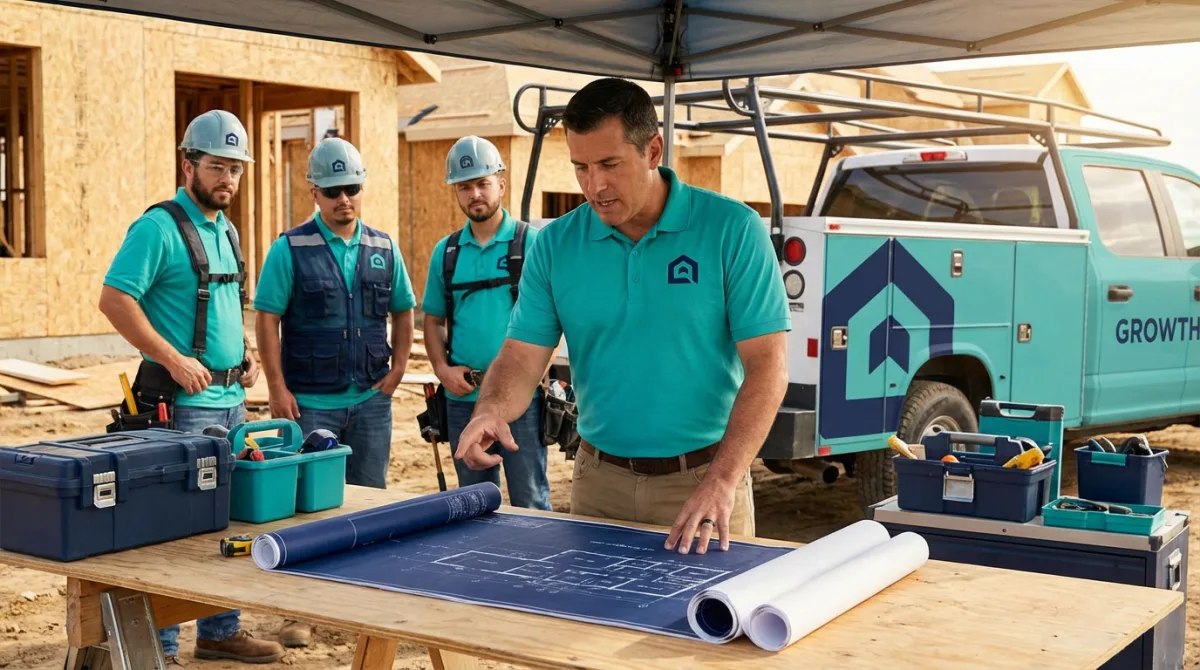
Scaling from Solo Contractor to a Full Crew
Scaling a contractor business from a one-person operation to a crew-based company is one of the biggest transitions in the trades. It’s also one of the most misunderstood. Going from doing all the work yourself to managing people, payroll, insurance, and systems requires a fundamentally different mindset — and getting it wrong can be more expensive than staying solo.
This guide walks through the critical decisions: recognizing when it’s time to hire, choosing between employees and subcontractors, managing the insurance implications, learning to delegate effectively, and building the operational systems that make growth sustainable instead of chaotic.
Signs It’s Time to Scale Beyond Solo
Not every solo contractor should build a crew. Some operators are happier and more profitable staying small. But certain signals indicate that your solo ceiling is becoming a business bottleneck:
You’re turning away work consistently. If you’ve said “I’m booked out 4-6 weeks” more than a few times in the past quarter, you’re leaving revenue on the table. Homeowners often won’t wait — they’ll call the next contractor on the list.
Your income has plateaued. There are only so many hours in a day. Once you’re fully booked at your maximum rate, the only way to increase revenue is to add capacity. If you want to earn more without raising prices to a point the market won’t bear, you need more hands.
You’re the bottleneck on every project. When nothing moves forward without you physically present, vacations become impossible, illness shuts down the business, and burnout is inevitable.
Larger projects are passing you by. Commercial jobs, multi-phase residential projects, and general contractor subcontracting opportunities often require a crew. No one hires a solo operator for a 10-unit apartment turnover.
You want to build equity, not just income. A business that depends entirely on your labor has limited resale value. A business with systems, employees, and a client base is an asset.
Employee vs. Subcontractor: The Critical Choice
This decision affects your taxes, insurance, liability, quality control, and legal compliance. Getting it wrong can result in IRS penalties, unpaid employment tax bills, and lawsuits.
Employees
Pros:
- Direct control over schedule, methods, and quality
- Consistent availability — they work your hours
- Better for brand consistency and customer experience
- Eligible for your training and development programs
Cons:
- Payroll taxes (employer share of Social Security, Medicare, FUTA, SUTA)
- Workers’ compensation insurance required
- Benefits expectations (health insurance, PTO)
- Administrative burden (payroll processing, tax filings, compliance)
- Harder to scale down during slow seasons
Subcontractors
Pros:
- No payroll taxes or benefits obligation
- Flexible — scale up and down with demand
- They carry their own insurance and tools
- Simpler administrative requirements
- Can bring specialized skills for specific projects
Cons:
- Less control over schedule, quality, and methods
- IRS has strict rules about classification — if you control the how, when, and where, they’re legally employees regardless of what your contract says
- If a sub doesn’t carry insurance, you may be liable
- Inconsistent quality can damage your reputation
The IRS Test
The IRS looks at three primary categories when determining worker classification:
- Behavioral control — Do you control what the worker does and how they do it?
- Financial control — Do you control the business aspects (tools, expenses, opportunity for profit/loss)?
- Relationship type — Is there a written contract? Benefits? Permanency?
The more control you exercise, the more likely the worker is legally an employee. Misclassification can result in back taxes, penalties, and interest. When in doubt, consult a tax professional.
Insurance Implications of Scaling
Adding crew members significantly changes your insurance requirements and costs. Understanding this before you hire prevents costly gaps in coverage.
Workers’ Compensation
In most states, workers’ comp becomes mandatory once you have employees. Even in Texas, where it’s technically optional for private employers, going without it exposes you to significant personal liability if a worker is injured.
Workers’ comp premiums are based on:
- Your trade classification (roofers pay more than painters)
- Total annual payroll
- Your experience modification rate (EMR) — a clean claims history keeps this low
- State rates
Budget for workers’ comp as a fixed percentage of payroll when estimating your scaling costs.
General Liability Adjustments
Your general liability premium may increase as you add employees because more people on job sites means more risk of property damage or third-party injury. Notify your insurance agent before hiring — coverage gaps during scaling are a common and dangerous oversight.
Commercial Auto
If employees will drive company vehicles or their personal vehicles for business purposes, you need commercial auto coverage — and possibly hired and non-owned auto coverage.
For a comprehensive breakdown of every insurance type and what it covers, see our contractor insurance guide.
Your First Hire: Getting It Right
Your first employee sets the tone for your entire company culture. Hire carefully.
Where to Find Good Candidates
- Referrals from other contractors — The best hires in the trades come through word of mouth
- Trade schools and apprenticeship programs — Eager learners who want to grow
- Job boards specific to trades — Indeed, ZipRecruiter, and local construction job boards
- Your existing subcontractor network — A sub you’ve worked with and trust might be ready for a full-time role
What to Look For
- Reliability over raw skill. You can teach technique. You can’t teach someone to show up on time every day.
- Cultural fit. A skilled worker who clashes with your values or work ethic will poison the well.
- Growth mindset. Your first hire might become your crew leader. Choose someone with leadership potential.
- Clean driving record and background — especially important if they’ll be in customers’ homes.
Onboarding
Don’t throw a new hire onto a job site on day one with no guidance. Create a basic onboarding process:
- Company standards and expectations (put it in writing)
- Safety protocols and required PPE
- Customer interaction guidelines
- Tool and material handling procedures
- Communication systems (how to report issues, request supplies, log time)
Learning to Delegate Without Losing Quality
Delegation is the hardest mental shift for solo contractors. You’ve built your reputation on your personal quality standards, and handing work to someone else feels like a risk.
The Delegation Framework
Start with tasks that are:
- Time-consuming but not quality-critical (cleanup, material prep, demolition)
- Repetitive and easily standardized (painting preparation, basic installations)
- Below your skill level (you should be doing the highest-value work)
Progress to:
- Core trade tasks under your supervision
- Independent work with end-of-day quality checks
- Full project ownership with milestone check-ins
Create Standard Operating Procedures
SOPs are how you clone your quality standards. Document your most common processes:
- How you prep a surface before painting
- Your electrical rough-in checklist
- Plumbing fixture installation standards
- Cleanup and final walkthrough procedures
These don’t need to be novels. A one-page checklist with photos for each major task type is enough to maintain consistency.
Inspect, Don’t Micromanage
Check work at defined milestones rather than hovering. Review the rough-in before drywall goes up. Check the prep before paint goes on. Inspect the final product before the client walkthrough. This builds trust and gives your team ownership while maintaining quality gates.
Build Systems Before You Need Them
The contractors who scale successfully are the ones who build systems slightly ahead of their growth — not after things break.
Essential Systems for a Small Crew
Scheduling and dispatch: Use a digital system (Jobber, Housecall Pro, or even a shared Google Calendar) to assign crews to jobs. Pen-and-paper scheduling falls apart once you have more than two people.
Time tracking: Track labor hours accurately. This is essential for payroll, job costing, and understanding profitability per project. Digital time clocks with GPS verification prevent buddy-punching and ensure accurate records.
Job costing: Know your actual cost (materials + labor + overhead) for every job type. This tells you which services are profitable and which ones you’re losing money on. Without job costing, you’re guessing — and guessing leads to underpricing.
Invoicing and payments: Professional invoicing software (QuickBooks, FreshBooks) sends invoices promptly, tracks payments, and maintains records. Cash and check-only operations create accounting nightmares as you scale.
Communication: Establish clear communication channels. A group text thread works for two people; it falls apart for five. Consider a simple tool like Slack or even WhatsApp groups organized by crew or project.
Pricing Adjustments
Your pricing as a solo operator won’t work for a crew-based business. You now have overhead that didn’t exist before — payroll taxes, workers’ comp, vehicle costs, tools, insurance increases, and administrative time.
Recalculate your rates using the true cost of operating with employees. Many contractors underestimate this and end up working harder for less money after hiring. Our guide on pricing your services walks through the math.
Grow Your Pipeline as You Grow Your Team
More capacity means nothing without more clients. As you scale your crew, scale your marketing.
A flat-fee platform like House Escort keeps your client acquisition costs predictable even as you grow. Unlike per-lead models where your marketing spend scales linearly with growth, a flat monthly fee means adding a second crew doesn’t double your platform costs. You keep 100% of earnings from every job, whether your team is two people or twenty.
Try House Escort free for 1 month — keep 100% of your earnings → houseescort.com/provider
Frequently Asked Questions
When is the right time to make my first hire?
The clearest signal is consistently turning away work for more than 2-3 months. If your backlog is 4-6 weeks and growing, you’re leaving significant revenue on the table. Before hiring, ensure you have enough cash reserves to cover 2-3 months of payroll even during a slow period, and that your pipeline is strong enough to keep an additional person busy at least 80% of the time.
How do I afford workers’ compensation insurance as a small contractor?
Workers’ comp premiums are calculated as a percentage of payroll, so they scale with your workforce. For a single employee, the annual cost is often manageable — particularly for lower-risk trades. Many insurers offer pay-as-you-go plans tied to your actual payroll rather than estimated annual premiums, which helps with cash flow. Getting multiple quotes and maintaining a clean safety record are the best ways to keep rates competitive.
Should I hire an employee or start with a subcontractor?
If you need someone on a regular, ongoing basis and want control over quality and scheduling, hire an employee. If you need specialized help for specific projects or want to test demand before committing to payroll, start with subcontractors. Many contractors use a hybrid model — one or two employees as their core crew, supplemented by subcontractors for overflow work or specialized tasks.
How do I maintain quality control with a growing team?
Start with documented standard operating procedures (SOPs) for your most common tasks. Implement a milestone inspection system — check work at natural stopping points rather than hovering. Invest time in training during the first 30 days of any new hire. Establish a culture where reporting problems early is rewarded, not punished. Quality issues caught during the process are cheap to fix; quality issues caught by the client are expensive.
What’s the biggest mistake contractors make when scaling?
Hiring too fast without systems in place. Adding people before you have scheduling, job costing, and communication systems leads to chaos — you’ll spend more time managing problems than doing productive work. The second most common mistake is underpricing: not adjusting rates to account for the true cost of employees (payroll taxes, insurance, benefits, non-billable time). Scale methodically, build systems first, and price for profit with a crew, not just as a solo operator.