Concrete Contractor Business Tips to Grow
House Escort Team
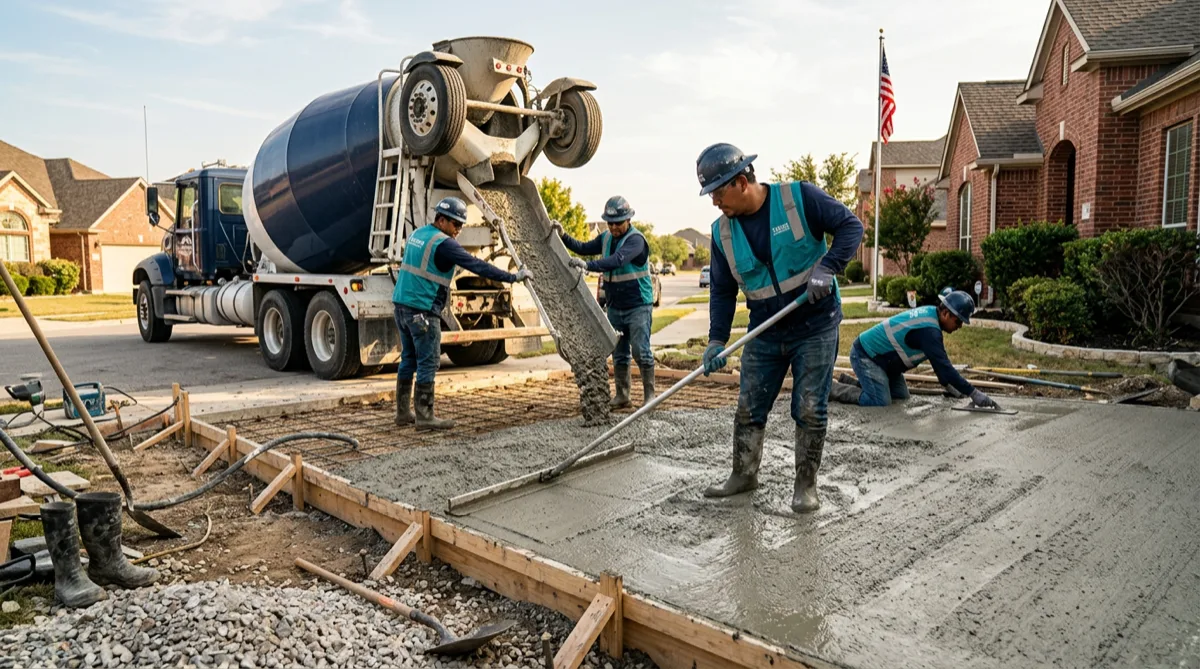
Concrete work is one of the most capital-intensive trades to enter and one of the most defensible businesses to build. Equipment requirements filter out low-end competition, and quality concrete work is highly visible — meaning every driveway, patio, and warehouse floor you pour is advertising.
But growing beyond a one-truck operation requires deliberate strategy. This guide covers the business practices that separate growing concrete contractors from ones who stay stuck doing the same volume year after year.
Price for Profit, Not to Win Every Bid
Concrete contractors frequently underprice residential work — winning lots of jobs while leaving money on the table or worse, losing money on problem pours.
Concrete pricing framework:
The price must cover:
- Material cost: Concrete typically runs $140–$180/cubic yard in Texas in 2026. A 400 sqft, 4” slab uses approximately 5 yards.
- Equipment cost allocation: Your mixer truck rental, screed rails, float, trowel machine, vibrator — these have real costs per hour and per job. Many contractors forget to allocate these.
- Crew labor: Time to form, pour, float, finish, strip, and cure. On a standard residential driveway, this is typically 6–10 crew-hours.
- Overhead: Truck depreciation, insurance, fuel, tools, business expenses.
- Profit margin: 15–25% gross margin is healthy for a concrete business. Less than 10% leaves no room for re-pours, warranty work, or slow months.
Avoid the “busy but broke” trap: Winning every bid at thin margins keeps you busy but starves your business of capital for better equipment, more crew, and higher-value projects. Calculate your actual cost per job — not just material cost — and price from there.
Contractor Bidding and Estimating Guide
Specialize and Move Up the Value Chain
Residential flatwork (driveways, patios, sidewalks) is competitive and low-margin because the barrier to entry is low — anyone with a pickup and a screed can pour a driveway (badly). The higher up the specialization curve, the more defensible your business becomes.
Higher-margin concrete specializations:
Stamped and decorative concrete: Adding texture stamps, color, and saw-cut patterns doubles or triples per-sqft pricing on patios. Few crews can do it well — the learning investment pays dividends for years.
Polished concrete: Commercial and industrial polished concrete (warehouses, restaurants, breweries, retail) requires specialized grinding and polishing equipment, but commands $8–$15/sqft versus $4–$6 for standard flatwork.
Tilt-up construction support: Tilt-up industrial buildings are booming in Texas logistics corridors. Specialty concrete work for wall panels requires precision forming and finishing skills.
Fiber-reinforced and specialty mixes: Contractors who understand high-PSI mixes, fiber reinforcement, and frost-resistant concrete (relevant in Dallas and Panhandle) can win industrial and municipal work others can’t bid.
Moving up the specialization curve means investing in training and equipment — but it also means fewer competitors, higher margins, and more interesting work.
Land Commercial and Municipal Accounts
Commercial and government work provides revenue predictability that residential projects cannot. A property management company with 50 apartment complexes in DFW is worth more than 50 individual homeowners — and they call you instead of you marketing to them.
How to land commercial accounts:
Property management companies: Call or email their maintenance directors directly. Offer a site visit to assess concrete condition. Position yourself as a partner for annual maintenance contracts — crack repair, joint sealing, trip hazard grinding, and periodic driveway replacement.
HOAs: Large HOAs need regular concrete maintenance (sidewalks, driveways, pool decks). HOA management companies handle dozens of HOAs and can be a multiplier account if you perform well.
General contractors: Build relationships with commercial GCs who need concrete flatwork subcontractors for their projects. Start with smaller jobs to build the relationship.
City and county bid boards: Texas municipalities post small concrete maintenance contracts (curb and gutter, sidewalk replacement, parking lot work) on local bid portals. Low volume, but predictable revenue.
Equipment Investment Strategy
Concrete equipment is expensive. The right investment sequence matters.
Equipment investment sequence for growing concrete businesses:
Phase 1 (0–$500K/year revenue):
- Own your basic finishing tools, screed, and forms
- Rent concrete pump trucks and specialty equipment per-job
Phase 2 ($500K–$1.5M/year):
- Purchase a ride-on trowel machine ($15,000–$30,000) — required for large commercial slabs and immediately increases per-day output
- Purchase your own laser screed if you’re doing large flatwork regularly
Phase 3 ($1.5M+/year):
- Consider owning a concrete pump (used: $150,000–$300,000)
- Own a concrete trailer if doing high-volume residential
The rule: own equipment that runs on every single job. Rent specialty equipment that only appears occasionally.
Texas-Specific Business Considerations
Heat management: Texas summer heat (June–September) is brutal for concrete placement. Early morning pours (starting at 6am) are essential in summer — concrete placed at 100°F cures too quickly, resulting in cracking. Your schedule and crew communications need to account for this.
Subgrade in Texas: Clay soils dominate much of central and east Texas. Proper subgrade preparation (compaction, sometimes subbase) is critical for slab performance. Doing this right — and explaining it to customers — differentiates professional work from low-bid concrete that cracks in 3 years.
Storm season: Spring and fall storms require flexible scheduling. Build weather contingency into your project timelines and communicate this to customers upfront.
Build Your Online Presence
Concrete work is highly visual. Polished slabs, stamped patios, and impressive commercial pours photograph well — use this.
- Maintain an active Google Business Profile with project photos
- Build a portfolio on your website or Facebook page
- Respond to every Google review within 24 hours
- Ask every satisfied customer for a Google review at project completion
Google Business Profile for Contractors
Grow Your Business Through House Escort
House Escort connects concrete contractors with homeowners and small commercial clients looking for trusted pros. No per-lead fees — respond to as many inquiries as you want for a flat monthly fee and keep 100% of what you earn.
Frequently Asked Questions
How do I find steady concrete work in Texas beyond residential driveways?
Focus on building relationships with property management companies, HOAs, and commercial general contractors. Attend local AGC (Associated General Contractors) chapter events in your metro area. Introduce yourself as a concrete subcontractor and ask about upcoming projects. Commercial accounts take longer to land than residential, but provide more predictable, higher-volume work.
What’s the best way to handle concrete re-pour warranties in Texas?
A standard residential concrete warranty covers workmanship defects (improper finishing, scaling, structural failure) for 1 year. Document the subgrade condition before pour (photos), note the ambient temperature, and specify the mix design on every job. If a customer has a legitimate warranty claim, handle it quickly — a re-pour that costs you $2,000 saves a relationship worth $20,000+ in future referrals.
How do I protect concrete in Texas summer heat during and after pour?
Pour early (before 10am if possible). Use retarder admixture when temperatures exceed 85°F. Start wet curing immediately after finishing — burlap and plastic covering or curing compound. Keep the slab moist for at least 7 days. On hot, dry, windy days, this is the single most important factor in preventing surface cracking.
Should a concrete contractor join any Texas industry associations?
TXAPA (Texas Asphalt Pavement Association) focuses on asphalt, but the American Concrete Institute (ACI) offers certifications that can be significant differentiators for commercial work. Locally, the Associated Builders and Contractors (ABC) Texas chapters provide networking, bid opportunities, and industry education.
How do I estimate concrete for a complex project with curved forms?
Calculate the volume (length × width × thickness in feet, divided by 27 = cubic yards), add 10% waste. For curved forms, break the area into triangles and rectangles and sum them. For sloped areas, account for the average thickness. When in doubt, add 10–15% — running short of concrete mid-pour is significantly worse than having leftover material.