Best Flooring for Texas Climate and Homes
House Escort Team
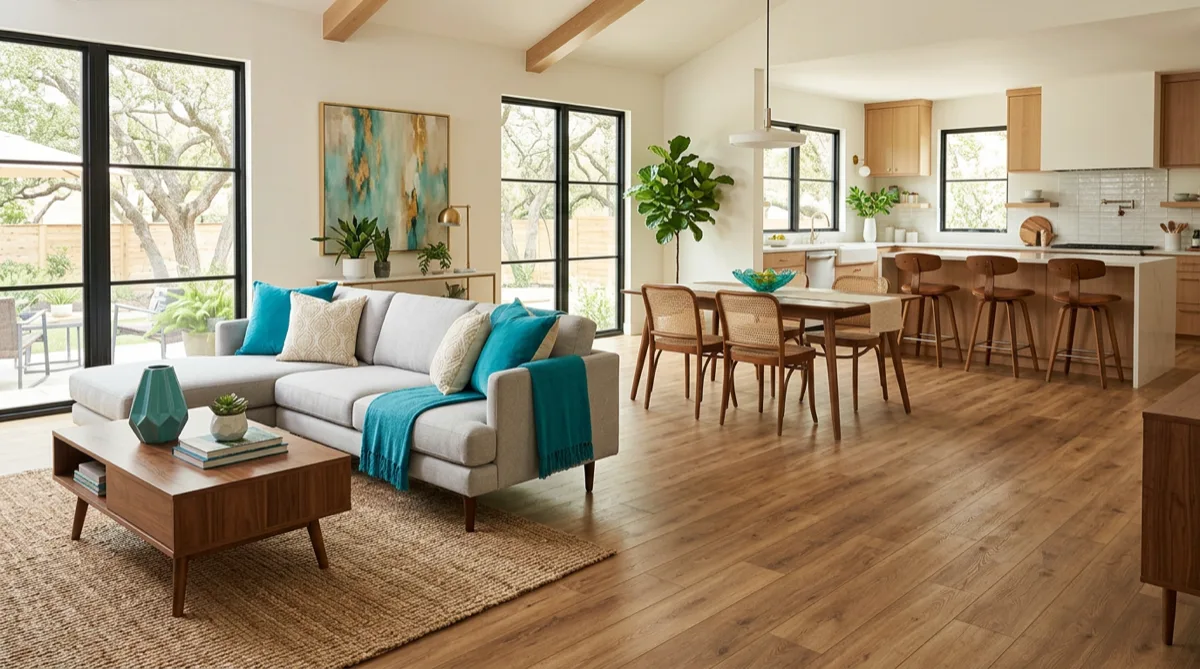
Texas’s climate — hot summers, high humidity in coastal and East Texas, slab foundations in most homes, and dramatic seasonal temperature swings — creates specific demands for flooring that buyers and renovators often underestimate. The wrong material shrinks, warps, delaminates, or feels uncomfortable underfoot within a few years.
Here’s a clear-eyed guide to the best and worst flooring options for Texas homes.
The Texas Home Flooring Context
Most Texas homes are built on concrete slab foundations — not wood-framed subfloors over a crawlspace. This matters because:
- Concrete transmits moisture: Ground moisture moves through concrete. Flooring materials that aren’t moisture-tolerant can buckle, delaminate, or grow mold on a slab.
- Concrete is hard and cold: Underlayment choices affect comfort significantly.
- Slab movement: Texas’s expansive clay soils cause slabs to move seasonally. Rigid flooring materials are more susceptible to cracking at expansion joints.
Beyond foundations, the humidity profile varies dramatically across Texas. Houston and coastal areas average 70–80% relative humidity year-round; El Paso and West Texas average 25–40%. The right flooring for San Antonio isn’t necessarily the right choice for Beaumont.
Best Flooring Options for Texas
Luxury Vinyl Plank (LVP) / Luxury Vinyl Tile (LVT) — The Top Choice
LVP is the most practical flooring choice for most Texas homes and has become the default upgrade material in Texas real estate for good reason:
- 100% waterproof core: LVP with a rigid WPC (wood-plastic composite) or SPC (stone-plastic composite) core handles ground moisture and the spills of Texas kitchen life without issue
- Dimensional stability: SPC cores are especially stable in temperature-swinging Texas climates — cars left in garages, bonus rooms above unconditioned spaces, and sunrooms are all LVP-friendly
- Comfort: Much softer underfoot than tile when installed over a foam underlayment
- Cost: $3–$8 per square foot installed, depending on quality tier
- Looks: Premium LVP products are visually indistinguishable from wood in most residential settings
For Texas slab homes across all climate zones, SPC-core LVP is the most risk-free upgrade decision.
Ceramic and Porcelain Tile — Excellent in Texas
Tile is impervious to moisture, dimensionally stable, and cool to the touch in summer — a benefit in a Texas climate. It’s been the dominant floor covering in Texas for decades for good reason.
Benefits:
- Unaffected by humidity, temperature swings, or moisture transmission through the slab
- Extremely durable — a well-installed tile floor lasts 20–30+ years
- Cool underfoot in summer (can be a drawback in winter)
Considerations:
- Hard and cold — area rugs help in living areas and bedrooms
- Grout lines require cleaning and periodic sealing
- Tile can crack along slab expansion joints; install with proper movement joints
- More expensive labor than LVP: $7–$15 per square foot installed
Porcelain tile with a wood-look finish is a popular Texas choice — it combines the warmth of wood aesthetics with the moisture invulnerability of tile.
Polished Concrete — Strong for Modern Homes
Many Texas homeowners opt to polish and seal their existing slab rather than covering it. The result is a durable, easy-to-maintain floor with an industrial-modern aesthetic.
- Cost: $3–$8 per square foot to grind, polish, and seal
- Extremely low maintenance
- No moisture concerns at all — it is the slab
- Cold and hard underfoot without rugs
Best suited for: modern aesthetic homes, open concept spaces, high-traffic areas
Engineered Hardwood — Viable With Caveats
Engineered hardwood (real wood veneer over a plywood core) is more moisture-stable than solid hardwood but still carries risk on Texas slabs in humid regions.
Where it works in Texas:
- Central Texas and drier regions (San Antonio west to El Paso)
- Conditioned spaces with stable humidity control
- Glue-down installation directly to slab (floating adds movement risk)
Where to avoid:
- Houston, Corpus Christi, East Texas — high ambient humidity creates seasonal movement even in climate-controlled homes
- Slab areas prone to moisture intrusion (near exterior walls, previously flooded areas)
Cost: $8–$15 per square foot installed. A worthwhile premium over LVP if aesthetics or resale positioning justify it.
Flooring to Avoid in Texas
Solid Hardwood
Solid hardwood is not recommended over concrete slabs — it can’t be glued down properly and floating solid wood over a slab creates chronic movement problems. Even when properly installed in a climate-controlled environment, Texas’s humidity swings cause measurable seasonal expansion and contraction.
Laminate Flooring
Standard laminate flooring (HDF core with a photographic surface) is not moisture-tolerant. A single leak, high-humidity basement area, or moisture intrusion through the slab can cause laminate to swell, buckle, and delaminate. In Texas’s climate, the upside doesn’t justify the risk compared to LVP, which offers better performance at similar price points.
Carpet in Wet Areas
Carpet in bathrooms, laundry rooms, or any space prone to moisture in a Texas home creates mold and mildew risk. In a humid Texas climate, keep carpet out of any space with moisture exposure.
Cost Overview: Texas Flooring Installed
| Flooring Type | Installed Cost per Sq Ft |
|---|---|
| LVP (mid-grade SPC) | $4–$7 |
| Ceramic tile | $7–$12 |
| Porcelain tile (wood look) | $9–$15 |
| Polished concrete | $3–$8 |
| Engineered hardwood | $8–$15 |
| Laminate | $4–$7 (not recommended) |
For a 1,500 sq ft home converting from carpet to LVP, budget $6,000–$10,500 for materials and labor.
Finding Flooring Contractors in Texas
Texas has no shortage of flooring installers, but the quality range is significant. What to look for:
- Ask specifically about their experience with slab installations
- Confirm they use proper moisture barrier or primer where required
- Ask about expansion gap specifications and movement joint placement
- Get a warranty on labor separate from the product warranty
House Escort lists verified, reviewed flooring contractors across Texas — you can find installers with documented project history in your specific area.
Find Flooring Contractors in Your Area →
Frequently Asked Questions
What is the best flooring for a Texas slab home?
Luxury vinyl plank (LVP) with an SPC (stone-plastic composite) core is the most practical choice for most Texas slab homes — 100% waterproof, dimensionally stable in temperature swings, comfortable underfoot, and available in quality tiers from $3–$8 per square foot installed. Porcelain tile is also excellent but harder and more expensive to install.
Can I install hardwood floors in a Texas home?
Solid hardwood is not recommended over concrete slabs. Engineered hardwood can work in drier Texas climates (Central to West Texas) when glued directly to the slab, but carries risk in humid areas like Houston. LVP provides a similar aesthetic with significantly less risk.
Is laminate flooring a good choice for Texas?
No. Standard laminate’s HDF core is vulnerable to moisture, which is a risk in any Texas home — particularly near exterior walls, in humid coastal regions, or in any space with potential moisture intrusion. LVP offers similar pricing with far better moisture performance.
How much does it cost to replace flooring in a Texas home?
Most Texas homeowners pay $4–$10 per square foot for LVP or tile installed, including removal of old flooring. A 1,500 sq ft project typically runs $6,000–$15,000 depending on material choice, removal needs, and any subfloor preparation required.
Does flooring type affect Texas home resale value?
Yes. Updated flooring is one of the top cosmetic factors in Texas resale. LVP and tile are currently the most broadly appealing finishes in the Texas market. Outdated carpet — particularly in living areas and hallways — is one of the most common price objection items in Texas home sales.